
 Cylindrical Cell Machine Line
 18650 Battery Pilot Line
 Pouch Cell Lab. Line
 Prismatic Cell Machine Line

Why Coated Electrode Rolls Fail Over a Weekend
A pilot team coats a full batch of cathode rolls on Friday afternoon, leaves them wound on the storage rack over the weekend, and starts building cells Monday morning. The first-cycle efficiency comes back lower than the previous batch and the DCIR histogram is wider, even though the slurry lot, the coating weight, and the calendering gap are identical. The coater logged no alarm. What changed is that the rolls sat for sixty hours, and almost no pilot line writes that number down.
The Rolls Are the Variable Nobody Logs
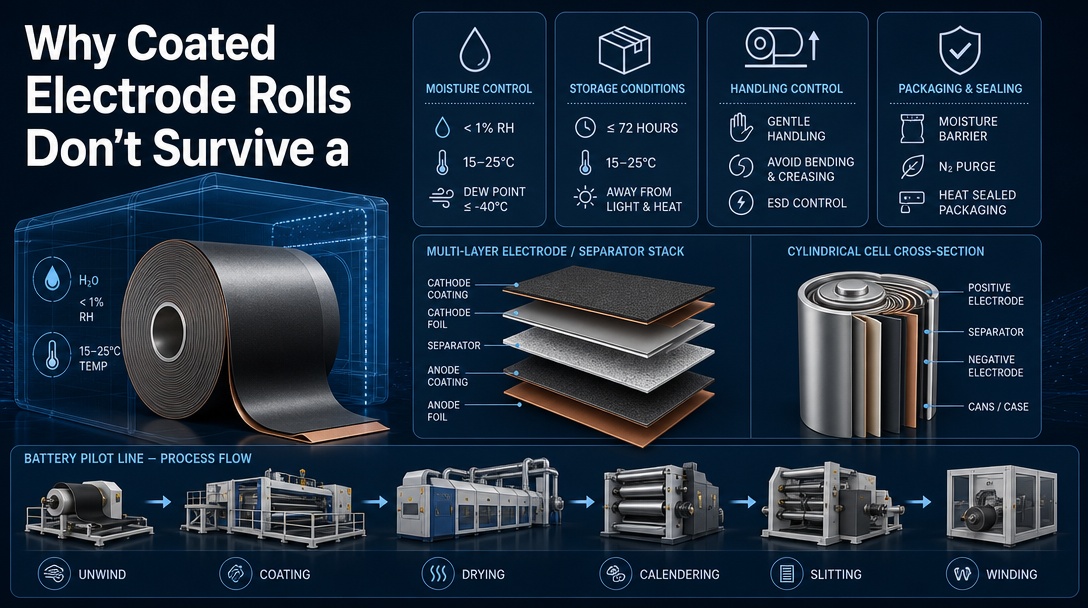
Pilot lines are usually careful about the process steps they can see. Coating weight, drying curve, calendering pressure, and slit width all get recorded and compared batch to batch. The time a coated roll spends waiting between the coater and the cell assembly area usually does not, because on paper it is not a process step. It is just where the roll sits.
That gap matters more on a pilot line than on a production line. A volume line is designed so that coated rolls are consumed almost as fast as they are produced; the queue is short by construction, and the storage area is a buffer of hours, not days. A pilot line runs in campaigns. You coat on one shift and assemble on another, and the rolls wait out the difference. A Friday coating run that feeds a Monday build is not an edge case on a pilot line. It is the normal rhythm, and it is where a controlled process quietly becomes an uncontrolled one.
Three things start to change the moment a coated roll stops moving: moisture, tension, and edge condition. None of them is visible on the coater log, and all three follow the roll into assembly.
Moisture Is the Slowest Leak in the Building
A dried electrode is not a dry electrode. The coating still holds residual solvent, the binder is hygroscopic, and the porous surface has a lot of area to adsorb water from the air. Leave a coated roll in ambient air for a shift and the surface moisture climbs; leave it over a weekend and the whole roll has equilibrated to the room.
For the cathode this is the more sensitive side, because PVDF and residual NMP hold water more readily than a typical anode coating. Moisture that goes into the cell does not stay harmless. It reacts to form HF, which attacks the cathode and the SEI, generates gas during formation, and shows up later as bloating in pouch cells, a weaker first-cycle efficiency, and capacity that fades faster than the baseline. A roll that measured fine at the end of coating can be out of spec by the time it reaches the stacker.
There is a second trap that catches teams who do move the rolls. A roll that has been sitting in a dry room is cold. Carry it out into a warmer, more humid area and water condenses on the foil and coating surfaces, which is worse than leaving it where it was. If your storage and your assembly area sit at different dew points, moving rolls in and out repeatedly adds moisture instead of removing it. Stable storage conditions matter more than a round trip through the dry room, and the specification work behind those numbers is covered in our note on dry room requirements for battery pilot lines.
Tension That Relaxes and Edges You Damage Once
A wound roll is under tension, and tension does not hold still for sixty hours. The web gradually relaxes, the layers settle, and the internal stress pattern the Winder created drifts. The practical result is a roll that unwinds differently from the way it was wound: the web wanders, tension control has to fight the change, and wrinkles can form where the pack has tightened unevenly. At a slitting or notching station that shows up as edge flutter and inconsistent slit width.
Edge condition is the part that can be lost permanently. Rolls that are stood on end, leaned against a wall, or stacked flat under their own weight load their edges and their outer wraps. Edge burrs, dents, and flat spots are then wound into the pack, and no later process step removes them. Core choice is part of this. Paper cores can shed fiber, take on moisture, and deform under load, while a rigid, correctly sized core keeps the roll round and lets you handle it by the core rather than by the coating. Our note on electrode slitting precision covers the cutting side; the point here is that edge quality you paid for at slitting only survives if the roll is stored and handled properly afterwards.
Why the Pilot Line Never Has a Queue Rule
Production lines enforce first-in-first-out and a maximum dwell time for work in process. Pilot lines rarely do, because the batch is small and someone is always about to build it. The roll becomes inventory instead of a process step, and inventory does not have a shelf-life clock unless you give it one.
The cost of this is not the occasional bad batch. It is that the pilot line loses the ability to attribute failures. When a Monday build underperforms, the team re-checks the recipe, the electrolyte, and the formation cabinet, which are all easy to see, and never suspects the rolls, which are not. The same blind spot becomes a real yield problem later, when the process is scaled and rolls can no longer be treated as free inventory. Tracking roll age and exposure is a cheap control that pays for itself the first time it saves you from reworking a chemistry that was never the problem.
What to Specify for Roll Storage and Handling
Most of this can be fixed at specification time, before the line ships, at far lower cost than adding it after commissioning.
| What to specify | Why it matters |
|---|---|
| Storage area held at assembly dew point | Prevents moisture pickup and condensation on cold rolls |
| Roll stands that support by the core | Keeps the coating and edges off the rack surface |
| Core type, size, and rigidity | Round rolls, no fiber shedding, consistent unwind |
| Maximum WIP dwell time per roll | Turns storage into a controlled process step |
| Roll labeling with coat time and exposure | Makes dwell time visible and attributable |
| Sealed storage with desiccant for long holds | Buys time when a build slips |
There is a real trade-off in how far you take this. A storage room held at assembly dew point costs floor space and continuous runtime, and vacuum-sealing every roll adds handling labor. Those costs only pay back if rolls regularly wait longer than a shift. If your pilot line consumes coated rolls within hours, a controlled rack and a dwell clock are enough. If it coats in campaigns and builds days later, the storage environment is part of the process and should be specified like any other station. Ask your equipment supplier what incoming roll runout and tension variation the unwinder can tolerate, because that number sets how much storage drift you can absorb before quality follows. Wangsheng specifies roll handling, unwind tension, and edge trim together with the coating line rather than treating storage as an afterthought, and we integrate electrode vacuum drying for teams that need to recover rolls before assembly.
Read the Rolls Before You Blame the Batch
The check that settles the argument is cheap. Cut a strip from the roll you are about to build, run a moisture measurement on it, and compare it against the roll you measured at the end of coating. If moisture moved, storage time is your answer. Run a peel test on a stored sample and compare it against the fresh one, because adhesion that relaxes on the rack behaves differently through calendering and winding. Log unwind tension on the first few meters of every roll and watch for rolls that come off the rack behaving differently from the day they were wound.
Re-drying in a vacuum oven will pull moisture back down, and it is worth doing when a build slips, but it does not restore edges that were crushed or tension that has already relaxed. Those losses are permanent, which is why prevention at the storage rack is cheaper than correction downstream. If your failures cluster on the batches that build after a gap, treat roll storage as the root cause before you touch the recipe. Our note on why calendered electrodes peel off the foil goes deeper on the adhesion side.
If you are laying out a coating and assembly line and want the storage and handling step specified with the rest of the process, contact Wangsheng with your batch rhythm and how long rolls usually wait. We will tell you where dwell time turns into a bottleneck, and what the storage area needs to hold to keep the quality you made at the coater.