
 Cylindrical Cell Machine Line
 18650 Battery Pilot Line
 Pouch Cell Lab. Line
 Prismatic Cell Machine Line

When Formation Temperature Drift Quietly Kills Your Cells
A pilot batch comes out of formation with a capacity spread of nearly five percent and a handful of DCIR outliers that no one can explain. The recipe is checked, the electrolyte is from the same lot, the coating weight was fine. The batch gets re-run on the same recipe and produces a different distribution. That is the moment to stop looking at the recipe and start looking at the cabinet, because a formation room that cannot hold temperature uniformity will hand you a different batch every time you press start.
The Batch That Looked Fine Until Aging
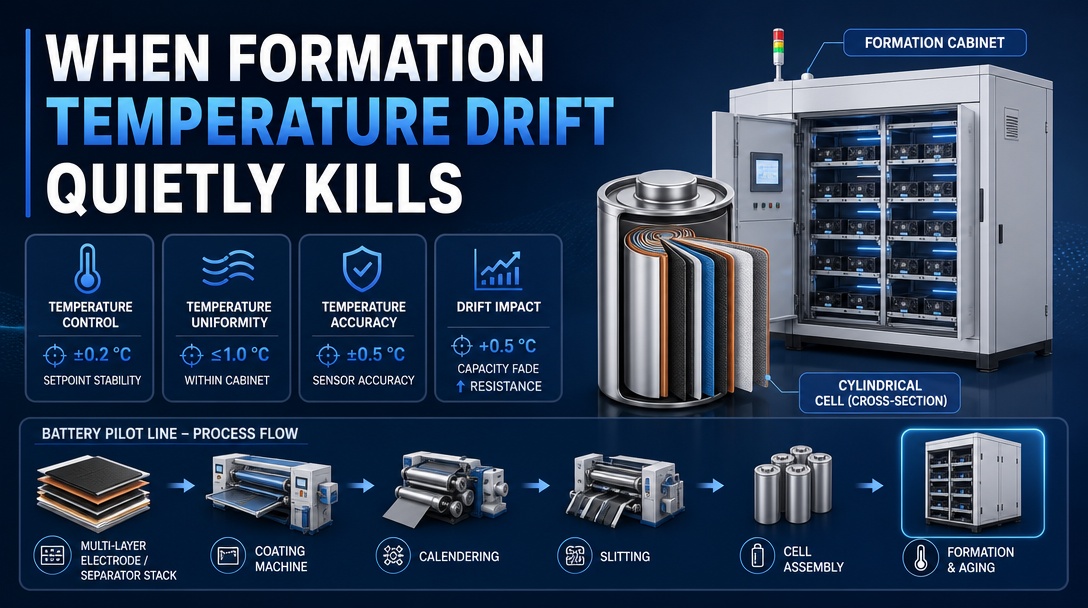
Right after formation, open-circuit voltage and capacity look acceptable. The problems surface later, during aging and grading, when the outliers separate themselves and the histogram refuses to tighten. By then the cells are built, the electrolyte is spent, and the only lever left is to bin more product.
Engineers blame the formation protocol first, because it is the one thing that was recently tuned. But when an identical recipe gives two different distributions in two different cabinets on the same day, the recipe is not the variable. Formation is an exothermic process, and the heat a cell generates during the first charge has to go somewhere. The cabinet is not an oven you set and forget. It behaves more like a heat exchanger, and heat exchangers fail quietly.
Heat Removal, Not Heat Supply, Is the Job
During the first charge, the SEI layer forms on the anode and a measurable amount of energy leaves each cell as heat. In a chamber with a hundred or more channels sitting shoulder to shoulder, that heat does not disappear. It accumulates in the middle of the shelf, where airflow is weakest, and drains away at the edges, where the cabinet wall acts as a heat sink.
This is why forced-air cabinets and cabinets with solid, tightly packed shelf layouts behave so differently, and why a chart of channel position versus capacity often looks like a smile: edge cells lower, middle cells higher. If your channel layout leaves no gap for air to move between cells, the cells in the center will run hotter than the cells at the end of the row, and their SEI will form under different conditions. No amount of recipe tuning corrects for that, because the recipe is uniform and the temperature is not.
Cell-to-Cell Spread Is What Actually Corrupts the SEI
SEI formation is temperature sensitive in both directions. Run a cell too hot and the film grows fast but porous, consuming extra lithium and electrolyte, which shows up as lower first-cycle efficiency and faster capacity fade. Run it too cold and the film forms slowly and unevenly, leaving patches that re-form during later cycles. A six-degree spread across a shelf is enough to move cells from one regime to the other.
The number that matters is not the average chamber temperature on the HMI. It is the spread across all channels at full load, and the repeatability of that spread from one batch to the next. A reading of 25.0 °C means very little if the cells behind it range from 22 to 29 °C. Once a chemistry is locked, batch-to-batch repeatability of temperature is what decides whether your formation data can be trusted for qualification, because a tight distribution that moves between batches is more dangerous than a wide one that stays put.
If your lab is still cycling through chemistries every few months, absolute accuracy matters less than simply knowing the true cell-level temperature. Once you commit to a chemistry and start qualifying cells against a specification, that tolerance becomes the whole ballgame. That is a trade-off worth naming before you buy a cabinet, not after.
Where Pilot Cabinets and Manual Racks Fall Short
Pilot lines rarely start with a purpose-built formation room. They start with manual racks, repurposed chambers, or a cabinet sized for a much smaller batch and then pushed past its design load. Three failure modes show up repeatedly.
First, the temperature sensor sits in the chamber air, not on the cells. It reports a comfortable average while the cell surfaces and the clamp contacts run warmer. Second, the channel spacing was chosen for count, not for airflow, so adding cells to fill the cabinet makes uniformity worse rather than better. Third, the clamp itself contributes: a worn or dirty contact adds resistance, and the resulting voltage drop and local heating shift the effective formation current for that channel only.
Wangsheng builds formation and grading equipment for pilot and small-volume lines, and the channel layout, airflow path, and clamp design are specified together rather than added one at a time. On pouch and prismatic cells there is a fourth variable, because the cells are formed under stack pressure, and uneven pressure across the stack compounds an already uneven temperature field. That coupling is covered in our note on why pouch and prismatic cells need stack pressure during formation.
What to Specify Before You Order
Most temperature specifications you will be quoted are measured in an empty or lightly loaded chamber. They are not wrong, they are just measured under conditions that never happen on a real line. Ask for uniformity measured at the cell surface, with a full load, using thermocouples on dummy cells.
| What to ask for | What it reveals |
|---|---|
| Uniformity at cell surface, full load | The real gradient your cells will see |
| Per-channel or per-zone sensing | Whether the cabinet can see a local hot spot at all |
| Channel spacing and airflow path | If uniformity survives a fully loaded cabinet |
| Clamp contact resistance and cleaning interval | Whether a single channel will drift on its own |
| Ramp and cool-down rate | How long the cabinet sits off-line between batches |
| Repeatability batch-over-batch | Whether qualification data is comparable over time |
Two supplier questions decide more than the datasheet. Ask for the temperature uniformity measured with the cabinet fully loaded and the test method behind the number, because a uniformity claim without a method is a marketing line. Then ask what the acceptance criteria will be at commissioning, since a full-load temperature map is the only sensible way to sign off a formation room. If the supplier cannot produce that map, no paper specification will help you later.
The Checks That Catch Drift Early
Once the cabinet is running, drift is easy to miss and cheap to catch. Load a full shelf of dummy cells with surface thermocouples and map the gradient before the first production batch, then repeat it every few months. Log channel position against capacity and DCIR during grading, and look for the smile pattern; if the outliers cluster by shelf position, the cause is thermal, not chemical. Check clamp torque and cleanliness on a fixed interval, and treat a single channel that drifts away from its neighbors as a root cause investigation rather than a data glitch to be averaged away.
None of this is exotic. It is simply the work that gets skipped when a pilot team is under pressure to produce cells, and it is the work that decides whether the capacity spread you see is a real process limit or an artifact of the cabinet. Treat formation temperature as a controlled process variable, not a room condition.
If you are specifying a formation and grading setup for a new chemistry, or chasing a capacity spread you suspect is thermal, contact Wangsheng with your batch size and the temperature uniformity you need at the cell. We will tell you what the cabinet can actually hold, and where the bottleneck really sits.