
 Cylindrical Cell Machine Line
 18650 Battery Pilot Line
 Pouch Cell Lab. Line
 Prismatic Cell Machine Line

When Aluminum Laminate Film Spec Decides Yield
A pilot line switches aluminum laminate film supplier, or pushes the forming depth a couple of millimeters deeper to fit a larger cell, and within a week the corners of the formed cases show hairline cracks. The pinholes only turn up after electrolyte filling. The Forming Machine gets blamed, the die set gets re-machined, and the cracks come back, because the film never had the elongation to survive that draw in the first place.
Pouch cell yield is set as much by a roll of film as by any machine on the line. The laminate is the cell's package, its moisture barrier, and its electrical insulator at once, and those three jobs pull the specification in different directions. A film chosen on price, or one bought against a datasheet written for a different pocket geometry, will pass incoming inspection and still fail on the line.
Inside a Roll of Aluminum Laminate Film
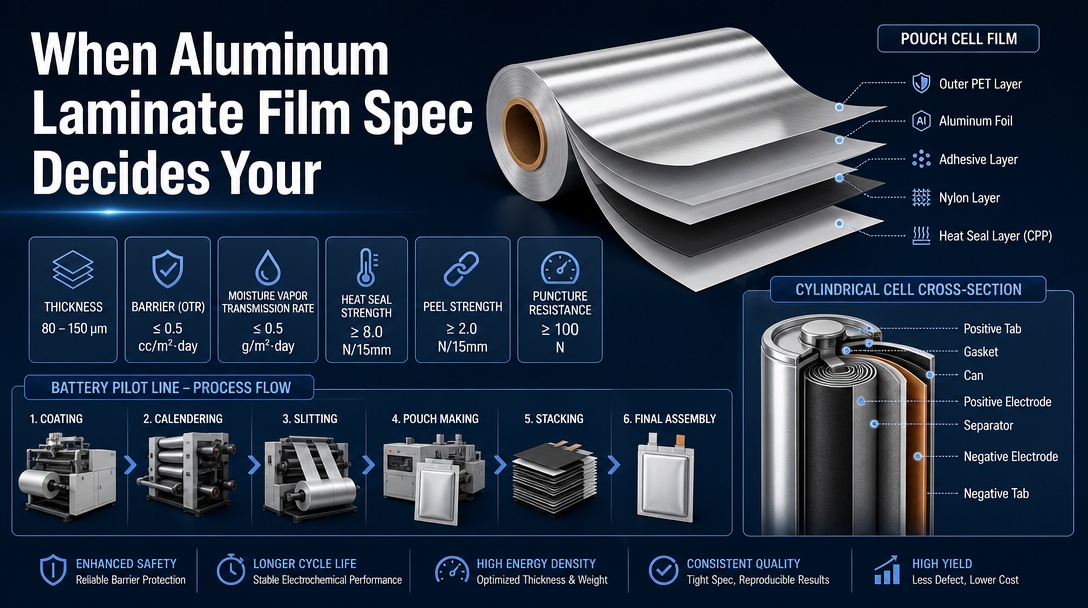
Three layers do three separate jobs, and none of them is redundant:
- Outer protective layer (usually nylon or PET). Puncture and abrasion resistance, plus the surface that carries printing and handling marks. Thin it too far and the film scuffs and tears on the line.
- Aluminum core. The only layer that genuinely blocks water vapor and gas. Everything the rest of the cell does to keep moisture out is wasted if this layer is thin, cracked, or has a poor surface treatment.
- Inner sealant layer (PP or CPP). Heat-seals to itself, tolerates electrolyte, and electrically insulates the case from the electrode stack and tabs.
The film supplier sets the balance between those three layers before you ever see the drum. The datasheet lists the numbers; it does not tell you which one was sacrificed.
Formability versus Barrier: The Trade-Off a Datasheet Hides
Aluminum thickness is where most of the confusion lives. A thicker, harder core resists water vapor better and shows fewer handling pinholes, but it cracks sooner at a tight corner radius. A thinner, softer core draws deeper without cracking, and then lets moisture through faster and folds into pinholes along the crease lines, which only reveal themselves after sealing.
There is a second variable that gets ignored: the aluminum temper. Two films with the same nominal thickness draw very differently depending on whether the core is fully soft annealed or partially hardened. If a forming die that worked with one film suddenly splits the corners of another, the thickness number is often identical and the temper is not.
The practical consequence: if your cell design needs a deep pocket and a thin film, that is not something you can fix on the forming machine after the fact. You either accept a thicker aluminum core, or you redesign the pocket. Teams that try to "tune it out" with more forming pressure are the ones that generate micro-cracks they cannot see.
The Sealant Layer Decides Whether Your Sealer Can Seal
The inner CPP layer is the part that has to survive the top-side and side sealing steps, and its thickness sets the process window. A thick CPP layer tolerates a wider spread of seal temperature and dwell, but it makes the film stiffer and harder to form into a deep pocket. A thin CPP layer forms beautifully and then produces weak seals at the tolerance limits of the sealer.
This is why a film that looks fine at forming can still leak weeks later, during formation or after degassing. The leak does not appear at the sealer; it appears after the cell has been through electrolyte and thermal stress. Our earlier note on why pouch cells leak after formation, not at the sealer covers that failure path in more detail.
The judgement call here is simple. If your sealer cannot hold temperature consistently across the full web width, no film will compensate for it. If the film's CPP layer is thin enough that a two-degree drift produces a weak seal, the sealer is the bottleneck, not the film. Decide which one you are actually fighting before you change suppliers.
Where the Defects Actually Surface
Formed cases should be inspected immediately after forming, not after filling. Three checks catch most problems early:
- Light-box or backlight inspection for creases and thin spots at the corner radius.
- Dye penetrant on the formed pocket to expose pinholes.
- An insulation (hi-pot) check across the formed film, before the stack goes in.
The failure mode that escapes all three is a micro-crack in the aluminum that stays closed until the cell is sealed and then opens under formation heat and internal pressure. By then the batch is built and the loss is a whole run, not a reject rate.
Wangsheng builds the aluminum film forming and top-side sealing equipment used in pouch pilot lines, and the film datasheet is requested before the forming die is cut. That is not bureaucracy: the punch radius and die clearance put a hard ceiling on draw depth, and no amount of press force changes it.
How to Qualify a Film Before You Commit a Batch
The purchase decision should rest on tests you or your supplier can reproduce, not on a single nominal number:
| Parameter | What to ask for | Why it decides yield |
|---|---|---|
| Water vapor transmission rate (WVTR) | Test method and value, per ASTM E96 or ASTM F1249 | Predicts the moisture load the cell will see over its life |
| Forming window | Maximum draw depth at your corner radius and its measured value | Sets the cell geometry you can actually build |
| Aluminum thickness and temper | Nominal, tolerance, and coil-to-coil consistency | The formability-versus-barrier trade-off in one number |
| Seal strength | Peel value measured at your sealer's real temperature, dwell, and pressure | The only seal number that predicts leaks |
| Electrolyte resistance | Soak test result and duration for the CPP layer | Swollen or delaminated sealant leaks later |
| Pinhole and hi-pot after forming | Defect count per unit area | Catches micro-cracks before filling |
Two supplier questions are worth more than the datasheet. First, what is your coil-to-coil variation on thickness and surface treatment, because averages hide the bad section of the drum. Second, what acceptance criteria will you sign on the purchase order, because a marketing datasheet is not a specification. If the supplier cannot name the test method behind a number, treat the number as decoration.
Sequence the Decisions Correctly
The most common cause of this whole problem is the order in which decisions get made. Teams pick the forming machine first, then buy film to fit it, then lose yield and look for someone to blame. The sequence that holds up is:
- Fix the cell geometry, including pocket depth and corner radius.
- Select a film with a documented forming window that covers that geometry.
- Size the forming die - punch radius, die clearance, and heating - to film, not the other way around.
- Set the sealer temperature window from the film's CPP specification.
- Run a seal peel test on formed pockets before releasing the recipe to the line.
A film change in the middle of qualification invalidates the seal recipe and sometimes the forming die. Treat it as a process change and re-qualify, rather than adjusting the line until it half works. Because Wangsheng ships pouch pilot lines as a connected forming-to-sealing sequence, a film substitution gets flagged at the line level instead of being discovered downstream in the formation room.
If you are selecting a film, or specifying a pouch pilot line around a cell geometry you have not built before, contact Wangsheng with your target pocket dimensions and the film datasheet you are working from. Matching the film, the forming die, and the sealer as one system is cheaper than chasing cracks one machine at a time.